
Ramadan During A Pandemic

As we enter the second year observing our Holy Month in the midst of a pandemic, many of us find ourselves frustrated and discouraged. Some of the best things about this month are going to the mosque for prayer, and breaking fast with friends and family, and giving back to our communities. This pandemic has made many of these things challenging if not impossible, depending on where you live. However, it is still very possible to get the most out of this blessed month. There are several things that we can do to still enjoy every moment of this blessed month.

Author: Rebecca Pena Hikal

As we enter the second year observing our Holy Month in the midst of a pandemic, many of us find ourselves frustrated and discouraged. Some of the best things about this month are  going to the mosque for prayer, and breaking fast with friends and family, and giving back to our communities. This pandemic has made many of these things challenging if not impossible, depending on where you live. However, it is still very possible to get the most out of this blessed month. There are several things that we can do to still enjoy every moment of this blessed month. 

Stay spiritually connected without community 

Community plays an important role in spiritual connections on the individual level. Lacking the physical sense of community this year because of the social distancing measures can cause many to feel a void, here are few ways you can stay spiritually connected. Most of your local mosques allow for you to connect virtually. Check with them to see what they offer. Deepen your religious understanding through podcasts. One episode of a podcast each day can go a long way. Check podcast platforms to see if Muslim speakers you like have podcast series you can follow during Ramadan. You also can find virtual Quran recitation groups in your area to join or you can create one with your friends. Reading the Quran with its translations and interpretations will feed your brain in addition to your soul. Quran.com includes translations and tafsir (interpretations) with every verse along with reflections from individuals from around the world. 

Try new recipes to satisfy those cravings 

Cooking for Ramadan can be difficult when you’re fasting from sunrise to sunset, so setting aside time to make some new recipes this year will change things up and satisfy all those cravings.  Our very own Marisa Lopez Chicote has been posting many delicious recipes on our blog. Take a look and try some of those.  To finish off iftar and help stay awake through night prayers, try making some Turkish coffee.  Serve with your favorite desserts — I recommend taking a look at some of Sister Marisa’s blog posts! 

Virtual iftars and suhoors

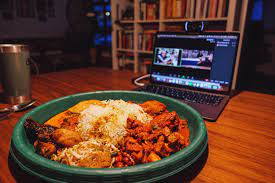
As much as we miss our gatherings with friends and family, you should stay safe. But just because you can’t invite guests over for iftar, doesn’t mean you have to have your meals alone. Setting up how many meals you want to share with others virtually and scheduling them in advance will give you some of that experience. For easier and more time-efficient scheduling, you can create a calendar for every meal you want to have with a virtual guest and share your information with friends and family. Calendy is a free app that you can use to do this. Friends and family will be able to see what days are available to them and sign up. They do not need to have an account, and the slots that are taken will not be available to other guests to see so you will not double book yourself.
Pray

Ramadan is a month of spiritual growth; it’s an opportunity to gain new habits that can continue throughout the year. For many Muslims, fulfilling their daily five prayers is one of the habits they want to leave Ramadan with.  Set goals. If you do not pray five times a day outside Ramadan, set prayer goals before Ramadan and follow up on a planner and calendar. Tracking your goals will help you set more realistic goals for future Ramadans and chart your progress during the year. If you already are in the habit of praying five times a day, consider adding extra prayers especially for nights. If you are struggling with prayer, find a prayer buddy to check on each other’s goals and encourage one another throughout the month. Set reminders. You can use the prayer app or set alarms on your phone if you need to pray around your schedule. Designate a space. Having your prayer-appropriate clothing, prayer beads and mat in a designated space will not only make it easier for you to accomplish your prayer goals, but also will get you in the mood for the holiday. Here in our home we have made a designated space strictly for prayer. ( see below)

Get festive and decorate 

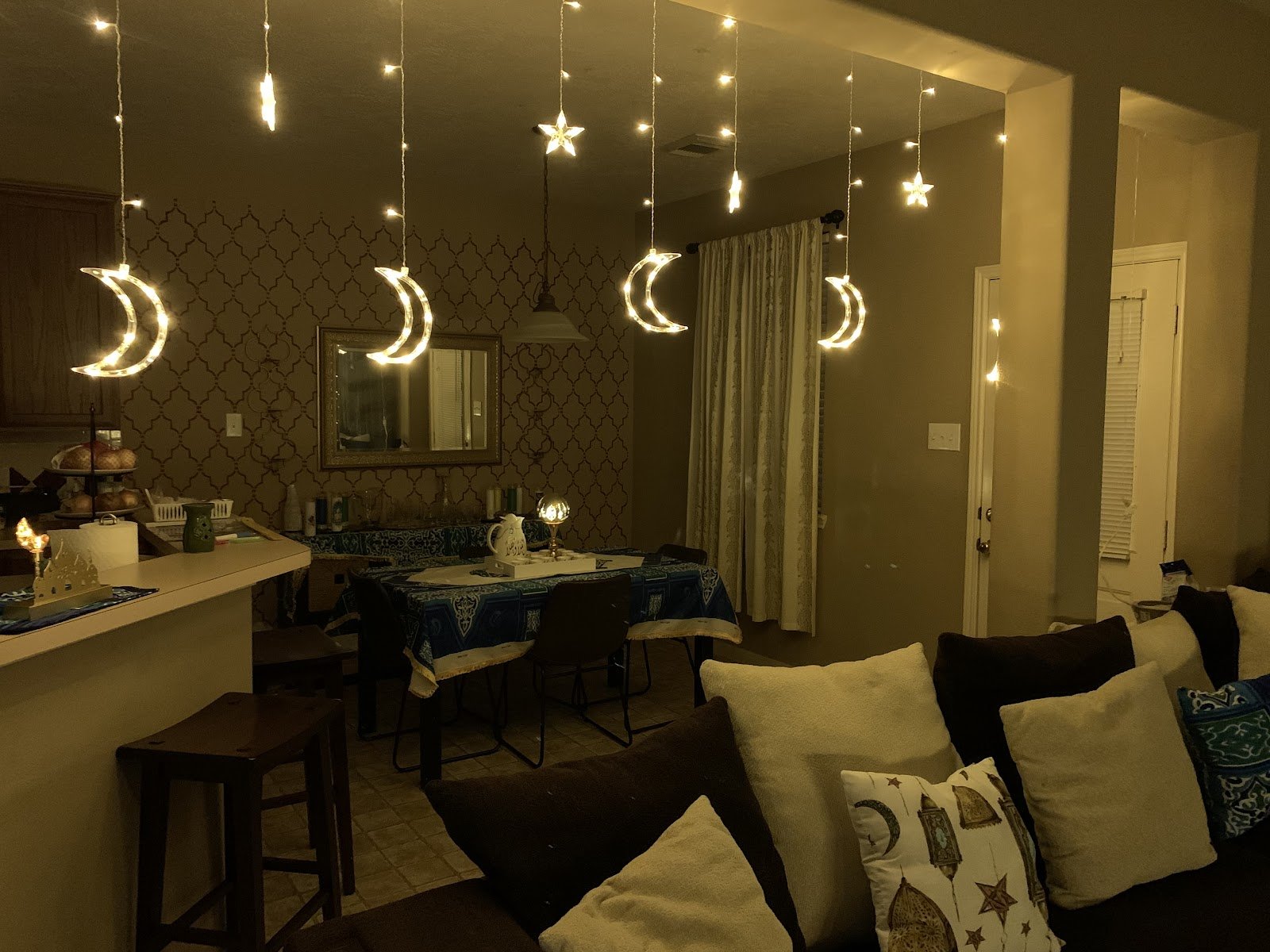
String up some lights, hang up “Happy Ramadan” signs and put together a date and dessert plate to fill your home with the Ramadan spirit. You can find many items on-line if you don’t already have some. I personally have used The Eid Shop and My Royal House. As you can see I have found many beautiful, affordable items. ( see below)

Donate and help others this Ramadan season 

Charity is important all year long, but it is believed to be much more rewarding during Ramadan. Many Muslim-run organizations depend on sadaqah (donations) for fundraising. Check out your local organizations and donate what you can. You can find many of these organizations throughout social media. 

Although, we’d hoped we would be spending Ramadan the way we have so many times before, it doesn’t mean we can not enjoy it all just the same. Remember what Ramadan is all about. Getting closer to Allah swt. Self reflection. Sure we miss all of the togetherness, but remember Allah swt is the best company we could be in.  

May Allah swt keep us all safe. InshaAllah 

Sister Rebecca is a SAHM living in Houston Texas. Married for 13 years with two children, and a revert since 2014,  her hobbies include cooking, reading, and spending time with family. 

The Importance of Avoiding Sinful Acts during the month of Ramadan – Rebecca Pena

Over the next few days I will be talking about sinful acts that  we should avoid during the month of Ramadan. Although as Muslims we should avoid sin at all costs all of the time, we should make an extra effort during this month in order for our fasts and duas to be accepted. May Allah keep us strong during this holy month. Ameen

Day 1: Backbiting

Abu Hurayrah ( radiyallahu ‘anhu) narrated that allah’s Messenger ( sallallahu’ alaihi wasallam) said: Whoever does not abandon falsehood in speech and acting on it, and behaving with ignorance, then Allah has no need for him to abandon his food and drink”

It has been mentioned before that moral violations harm the fast. If a person behaves sinfully, his fast may be valid, but his reward is lessened, or he loses his reward for fasting. 

What constitutes sin or moral violations? Sinful acts, sinful speech, sinfully looking at anything that Allah swt ( the most high) had prohibited. So what exactly  happens when we sin? Is our fast no longer valid or accepted? The fast is not invalidated, however, the reward is lost. There is no making up for that fast. Instead, he must repent for his immoral behavior. 

None of us are strangers to backbiting. In fact at times we may think that it’s no big deal. Whether at work talking about that one coworker. Or at a family gathering talking about that one cousin, aunt, uncle, sibling who stays in some sort of trouble.Or amongst friends when you’re talking about that one friend in the group who seems to love drama. Regardless of the circumstances involved, backbiting is a sin. One that brings severe punishment, whether what’s being said is true or not, Allah swt forbids backbiting. 

Backbiting

Backbiting is one of the major sins in Islam and Allah has strictly prohibited to backbite against any person, Muslim or Non- Muslim. Abu Huraira narrated that Allah’s messenger Prophet Muhhamed ( PBUH) said that: 

Backbiting is when you talk about a person behind his back ( and not in front of him) in a manner in which he would not like. Then the companions asked, “What if we mention the things in which are actually found in that person?’ Prophet Muhhamed (PBUH) replied that if those things are actually found in that person even then in fact you have backbitten him, and if those things are not present then you have slandered him. (Muslim) 

The above Hadith is stating that in both situations, whether the things are true or not, we as Muslims are not allowed to talk about a person behind his back. Allah has mentioned a severe punishment in the Quran for those who backbite. 

Allah says in Surah Al-Hujurat, verse 12:

“ O you who have believed, avoid much [negative] assumption. Indeed, some assumption is sin. And do not spy or backbite each other. Would one of you like to eat the flesh of his brother when dead? You would detest it. And fear Allah; indeed, Allah is accepting of repentance and Merciful” [49:12]

Through this verse, we are able to have a better understanding of the severity of backbiting. It can have horrible effects on individuals, families, and even societies. It is even punishable by crime in some places. So how can we avoid this?

  1. Fear Allah

When you are speaking to anyone, remember that Allah is watching and listening. Remind yourself what he says about backbiting in the Quran. Any involvement in any form of backbiting will not only pull you away from the mercy of Allah swt, but will get you closer to the trap of Shaytan.

  1. Fear Death

What were to happen if death were to fall upon us while we were in the middle of backbiting? Would anyone want to meet such an end? Hopefully this will help us to refrain from backbiting InshaAllah

  1. Put yourself in the shoes of the one being talked about

How would we feel if someone were backbiting us in the same way? Reminding ourselves of this will not only help us to avoid backbiting but it will also humble us and hopefully make us more compassionate and sympathetic towards others. 

  1. Avoid bad company and situations where there is backbiting

There are times when we ourselves are in situations whether it is with family or friends or even co- workers. Places and situations that we may not be able to avoid. The best thing to do is to try to avoid them by staying away from people who enjoy talking about others. If needed remove yourself from such situations by walking away when you can. 

  1. Stay silent 

The best thing that we can do when we are in situations that we may not necessarily be able to get ourselves out of is to stay silent. Remember your fast and the rewards that come with it, as well as the punishment that may come and the reward lost. 

If we are in constant  remembrance of Allah swt and of  the rewards this blessed month will bring, we should be able to avoid getting tangled up in any sort of backbiting. I pray that Allah swt  make things easy for us all . Ameen 

About the Author: Sister Rebecca is a SAHM living in Houston Texas. Married for 13 years with two children, and a revert since 2014,  her hobbies include cooking, reading, and spending time with family. 

Egyptian Ramadan traditions: Midfaa al Fetar – Marisa López

 I do not know if you have noticed that on TV and radio before the adhan of the Maghreb for fetar there is a sound of a cannon shot. Today we are going to find out where this custom comes from.

 The breakfast cannon, “Midfaa Al Fetar – in Arabic”, is another of the ancient Egyptian traditions of Ramadan.

 Legend has it that the beginning of the use of the cannon to announce the hour of fetar in Ramadan, was the result of a coincidence during the reign of the Mamluk dynasty in Egypt, on the first day of Ramadan 859 AH-1455 AD, after the  Egyptian Mamluk governor Khoshkadam received a cannon as a gift from a German.  owner of a cannon factory.

 The first test shot of the cannon was at sunset, the people of Cairo were delighted, they thought it was the announcement for the fetar.

  The next day, the heads of the neighborhoods went to the governor’s palace thanking him for the gift to the Cairotas, the sultan was satisfied with the idea and consequently ordered the cannon to be fired every day of Ramadan at sunset announcing the  breakfast time.

 The nickname of the cannon also its legend.  The cannon stopped working after a few days and the neighbors went again to the governor’s palace and were received by his wife Fatima and she was in charge of talking with her husband so that the cannon would work again and by those he is known by the nickname  from the canyon “Hagga Fatima”,

 The cannon began to function again, and is named after the name of the governor’s wife, and until this time, a cannon is placed on the Muqatam plateau near the Cairo citadel to announce fetar.

 The tradition spread from Egypt to the entire Muslim world, starting with the Levant region where it has the same nickname.

 Very good day everyone.

About the Author: Marisa Lopez Chicote is an event planner and mother of 5, living in Cairo and Muslim since 1985, alhamdullah. I love travelling and cooking.